

Q3 2022 GDP Report
Quarterly GDP Review and Discussion by Squord Team

Gross Domestic Product (GDP) measures the total value of goods and services produced in a country during a given period. Tracking this number is important because it helps paint a picture of how productive and prosperous a country is.
The GDP measure has some limitations, for example free/volunteer work is not counted - so all the times I helped change the light bulbs in my house for free are sadly not recognized as part of GDP - if they were, GDP growth rate will be higher! P.S subscribing to our newsletter is also free!
Informal sector is the part of any economy that is neither taxed nor monitored by any government agency. Most activities in the informal market are not captured in the GDP largely due to difficulty of reliable data collection. World Economics estimates that Nigeria’s informal sector could be as much as 57% of our GDP (perhaps we may have a separate article about this). Finally, the “underground economy” (illegal activities) is also not included in GDP.
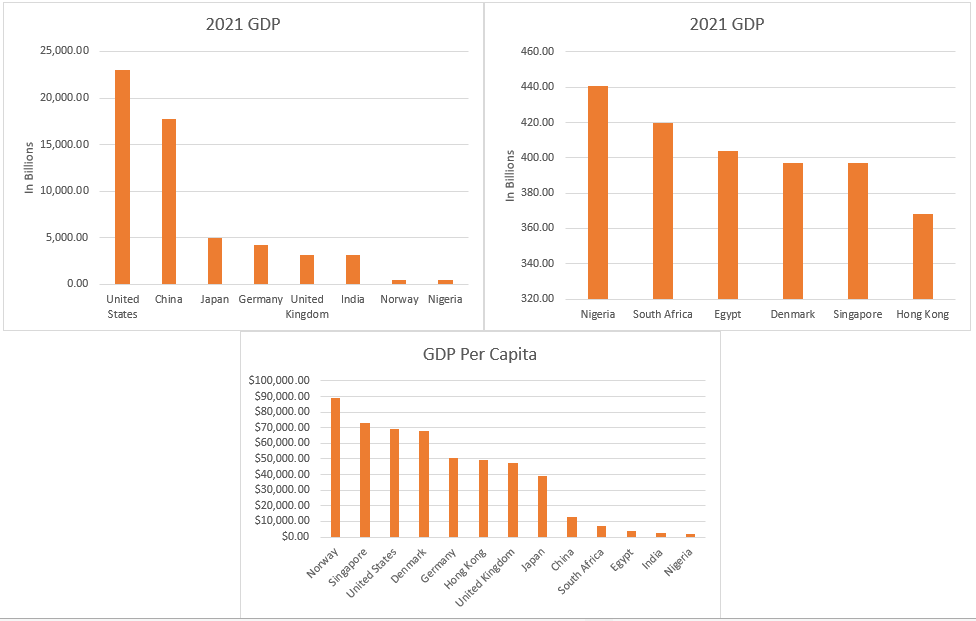
So what does Nigeria’s official GDP look like? What is the dollar value of total goods and services produced by a country of over 150 million people? Well, in 2021, the total value of goods and services produced in Nigeria was about $440 billion. So far in 2022 (January to September), Nigeria’s GDP stands at $324 billion.
GDP does not tell all. Nigeria has a larger GDP than Denmark, Singapore and Hong Kong. However many developmental data show average quality of life in those countries trumps that of Nigeria. As a country, Nigeria may produce more than Singapore, but if you look at Singapore’s production relative to their population, they produce more than enough wealth to cater for the needs of their population. Meaning, high GDP is one thing, but the better job is to create sufficient economic activities to generate wealth for your population.
One person makes and drinks one glass of orange juice (satisfaction, productivity). Ten people come together and could only make one glass of orange juice (insufficient, low productivity).
From Q3 2021 to Q3 2022, the economy (GDP) grew by 2.25% (after adjusting for inflation). That was the lowest growth rate in 15 months! Lower than 4.03% recorded in the same quarter of 2021 and downwards from 3.54% recorded in the preceding quarter.
The ideal desire is for GDP to consistently grow. A slow down in the rate of growth, or lack of any growth is an indication of challenging conditions that have affected productive activities. So after establishing that the economy grew by a lower rate in Q3, our next action was to find the culprit - which sector had the biggest slump in productivity/creation of value and what caused that to happen?
Oil vs Non-Oil
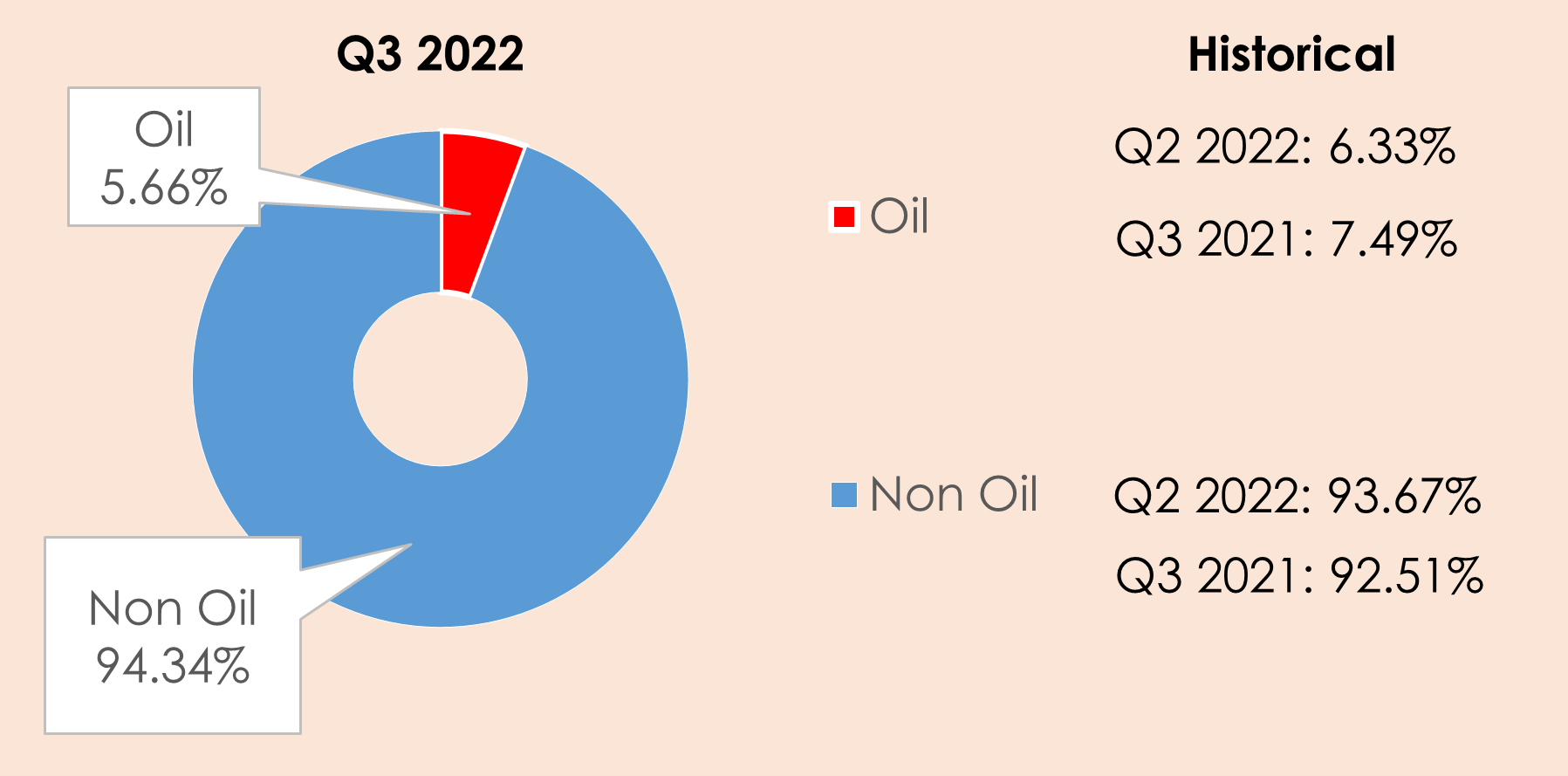
For many, when they think about Nigerian economics, the first thing that comes to mind is “oil”. Nigeria’s government earns most of their revenue, and most of their foreign currency income from oil. From the 2022 budget, the government expects to earn 51% of their revenue from the oil sector. While oil is a dominant factor for the government’s income, it plays a less dominant role in GDP of the entire country. Looking at the Country’s Q3 GDP report, the oil sector contributed 5.66% while the non-oil sector contributed 94.34%. Meaning oil sector activities only made up 5.66% of the total goods and services produced in the country.
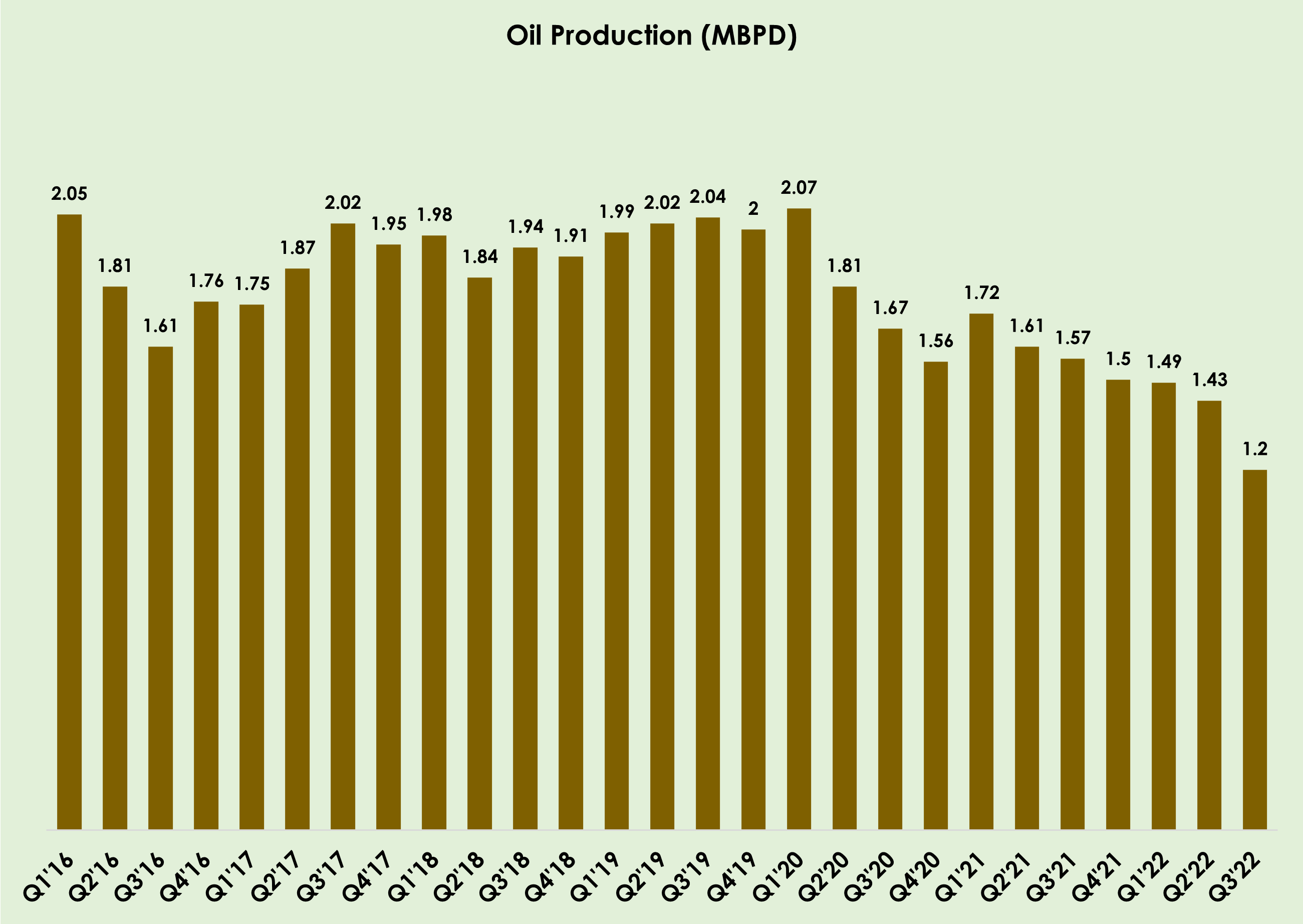
Ideally production levels should increase as technology advances, sadly this hasn’t been the case.
The oil sector growth at -22.67% in Q3’22 (Q3’21: -10.73%), indicates continuous decline in production in the sectors. The challenges facing the oil sector include:
Continued lack of infrastructure
Divestment by International Oil Companies (IOCs)
Oil theft, pipeline vandalization, diversion, and other operational challenges
Declining oil production as a result of oil rig shut-down
The oil sector contributed 5.66% to real GDP in Q3 2022, down from Q3 2021 and Q2 2022, where it contributed 7.49% and 6.33% respectively.
The non-oil sector grew by 4.27% in Q3 2022; lower by 1.18% in comparison to Q3, 2021 figure of 5.44% (Q2 2022: 4.77%).
The primary drivers of the sector are Information and Communication (Telecommunication); Trade; Transportation (Road Transport); Financial and Insurance (Financial Institutions); Agriculture (Crop Production) and Real Estate, accounting for positive GDP growth.
In real terms, the non-oil sector contributed 94.34% to the GDP in Q3 2022, higher than Q3 2021 (92.51%) and Q2 2022 (93.67%).
GDP Sector Analysis
One way of reviewing the GDP is Oil vs Non-Oil, another way is breaking it into 3 categories - Agriculture, Industries, and Services.
If you study history of global economies, you may see a pattern in developed worlds - Agriculture-led economy grows into the industrial revolution, and at the turn of the 21st century, they become a service-driven, tech-savvy economy. The United States and Britain come to mind. From cotton and tobacco farming to railroads, and coal-fired factories, to the likes of Google, and Wells Fargo.
Some say, proudly, that Africa leapfrogged the industrial revolution and went to services/digital. Then they point to awesome tech companies and banks to make their point. Q3 GDP report supports this narrative. However, my question is, did we ever push the limits in Agriculture and Industrial? With food scarcity and lack of scalable factories, I will say there is still a lot to be done. Being a service-led economy does not mean abandoning the other sectors. The Q3 GDP report shows that there is a lot of room for more growth and more value creation across board.

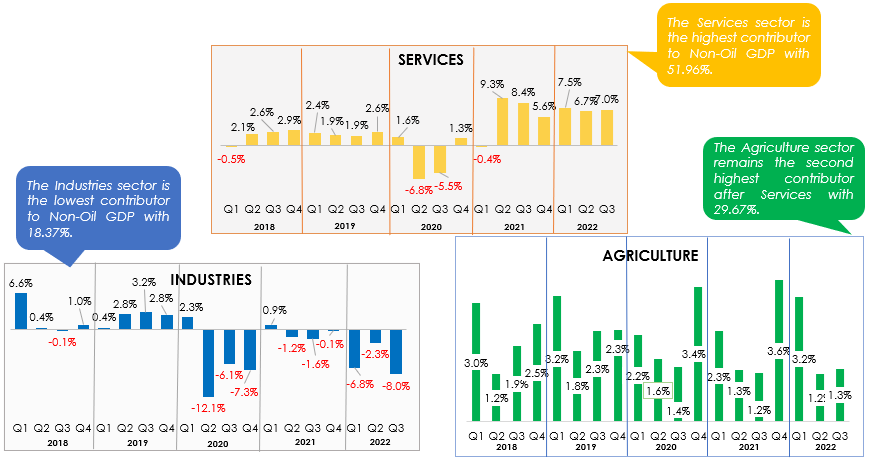
The Services sector remains the highest contributor to GDP with 51.96%.
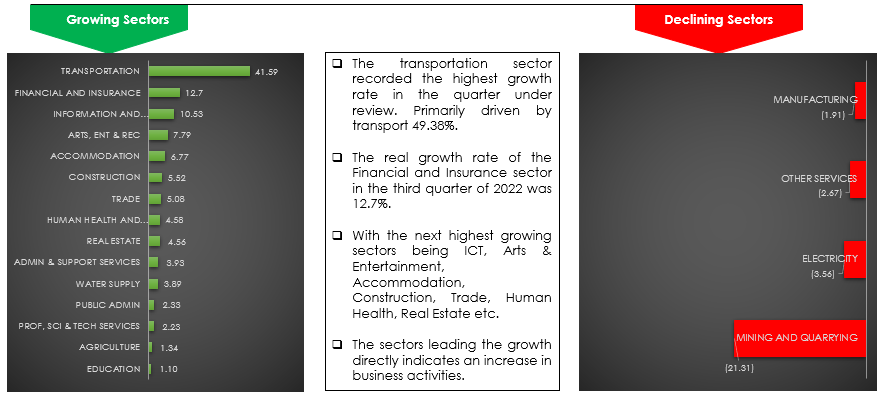
Recording growth of 7.01% which is higher than 6.70% in Q2, 2022 and lower than 8.41% in Q3 2021. This is as a result of performances in the Finance and insurance sector which rose by 12.7%, the ICT sector and the trade sectors, at 10.5% and 5.1%, respectively in the period under review.
The Agriculture sector remains the second highest contributor with 29.67%
The sector grew by 1.34% in Q3 2022, which is higher than 1.22% in Q3 2021 and 1.20% in Q2 2022. The four sub-activities making up the agricultural sector growths are as follows:
Crop Production= 1.33%
Livestock = 1.55%
Forestry = 2.19%
Fishing = 0.36%
The Industry sector is the lowest contributor to GDP with 18.37% in Q3 2022.
The total value of productivity from this sector declined by 8% in Q2 2022 compared to value generated in Q2 2022. The industrial sector has been on a decline all year. GDP in the industrial sector fell by 6.81% in Q1 2022, then further fell by 2.3% and and 8% in Q2 and Q3 respectively.
Sector Growth Trend
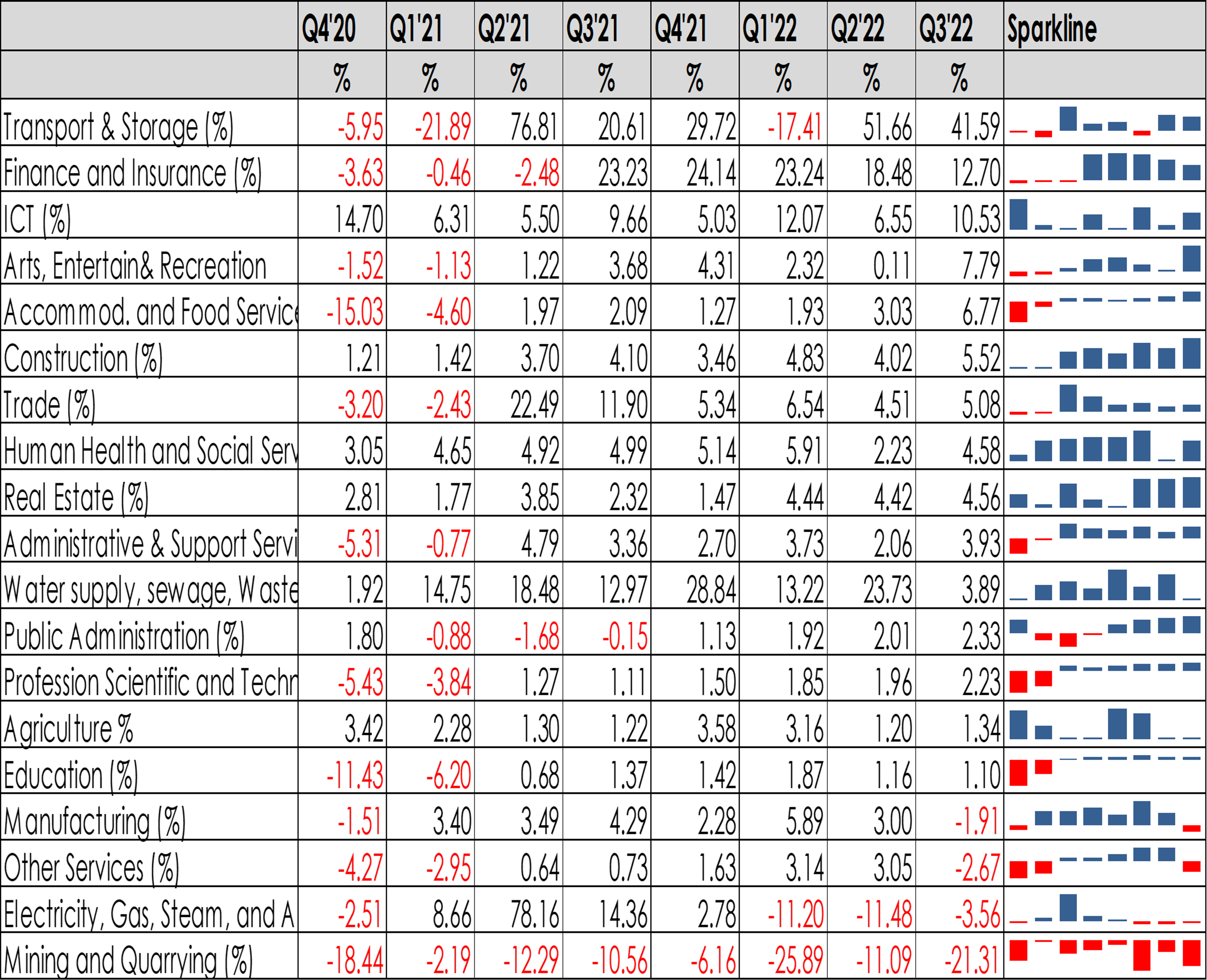
We can further categorize the Country’s GDP into 19 specific sectors.
Outlook
Inflation in Nigeria accelerated for a ninth straight month to 21.09% in October 2022, the highest rate since September 2005 and well above the central bank’s target range of 6%-9%. Following global trend of inflation response, the Central Bank of Nigeria (CBN) has made several attempts to tighten its monetary status through the excess liquidity mop-up to curb demand-pull inflation. At its November 2022 meeting, the CBN raised its monetary policy rate to 16.5%. Making it the fourth rate hike this year following a hike in May (13.5%). Thus increasing borrowing costs to the highest since February 2019.
We expect that the rate increase would have mixed effects on the economy. Manufacturers may struggle with high borrowing costs and the possibility of further currency depreciation due to scarcity of foreign currency.
There is sufficient reason to believe that the GDP growth trend, where there is economic growth, but at a declining rate, will continue.
Inflation, will remain elevated, further depleting consumers’ disposable income.
Social cracks and uncertainties ahead of the February 2023 elections could slow down economic momentum.
Transport and storage, Accommodation, and Food Services Arts, Entertainment, and Recreation to record growth on the back of the holiday season and election season.
However, the transport sector could be dampened by fuel scarcity, impacting the price of goods and services amidst the yuletide season.
Agriculture especially Crop farming to continue its declining growth; hinged on widespread flooding across Nigeria.
Finance and Insurance Sector to maintain its trajectory on the back of election spending, increased investment in the money market attracted by the rate hikes, as well as the increased activities of payment system banks and fintechs on financial inclusion.
The rate hikes and election uncertainties may lead to sell-off across stocks as investors reallocate to safer, high interest fixed income instruments.
Real estate and Construction Sector, which is largely driven by government participation, may suffer neglect in the coming months as incumbent government prioritize election activities.
Oil sector may remain dampened due to inefficiencies, low investment, and inability to meet production output even as the massive theft persists.
ICT to continue its trajectory from data subscription usage and increased data demand due to the rising remote work model. However, the implementation of the 5% tax on airtime from June 1st, 2022, could impede growth adversely impacting both operators and consumers.
As we said at the beginning of this article, formalizing the informal sector seems to be the low hanging fruit to increase Nigeria’s GDP “overnight”, and position it for higher subsequent growth. Secondly, thinking of GDP on a per capita basis as opposed to absolute terms. What was population growth like this past quarter? Is population growing faster than GDP? Top-down thinking - given a population of 200 million people, what is a decent GDP per Capita? This answer then gives us a decent GDP. Then set 5 - 10 year target growth rates across the 19 sectors with aligned policies as well. Begin with the end in mind. This way policy makers and businesses can take a more proactive position to GDP.
 | A guest post by
|